Overview
Massive star formation requires extreme temperatures, densities, shocks, and turbulent conditions. Such conditions are often found in super star clusters which are defined by their high luminosities (over 2,000,000 Lsun), compact sizes of a few parsecs, young ages of 100000 yrs, and contain hundreds of very massive stars greater than 8 Msun. I am interested in using archival observations as well as proposing for my own observations on ground-based (ALMA, Magellan, Gemini South) and space-based (Herschel, Spitzer, Hubble, SOFIA, JWST) instruments to study the birthplace of extremely massive stars.
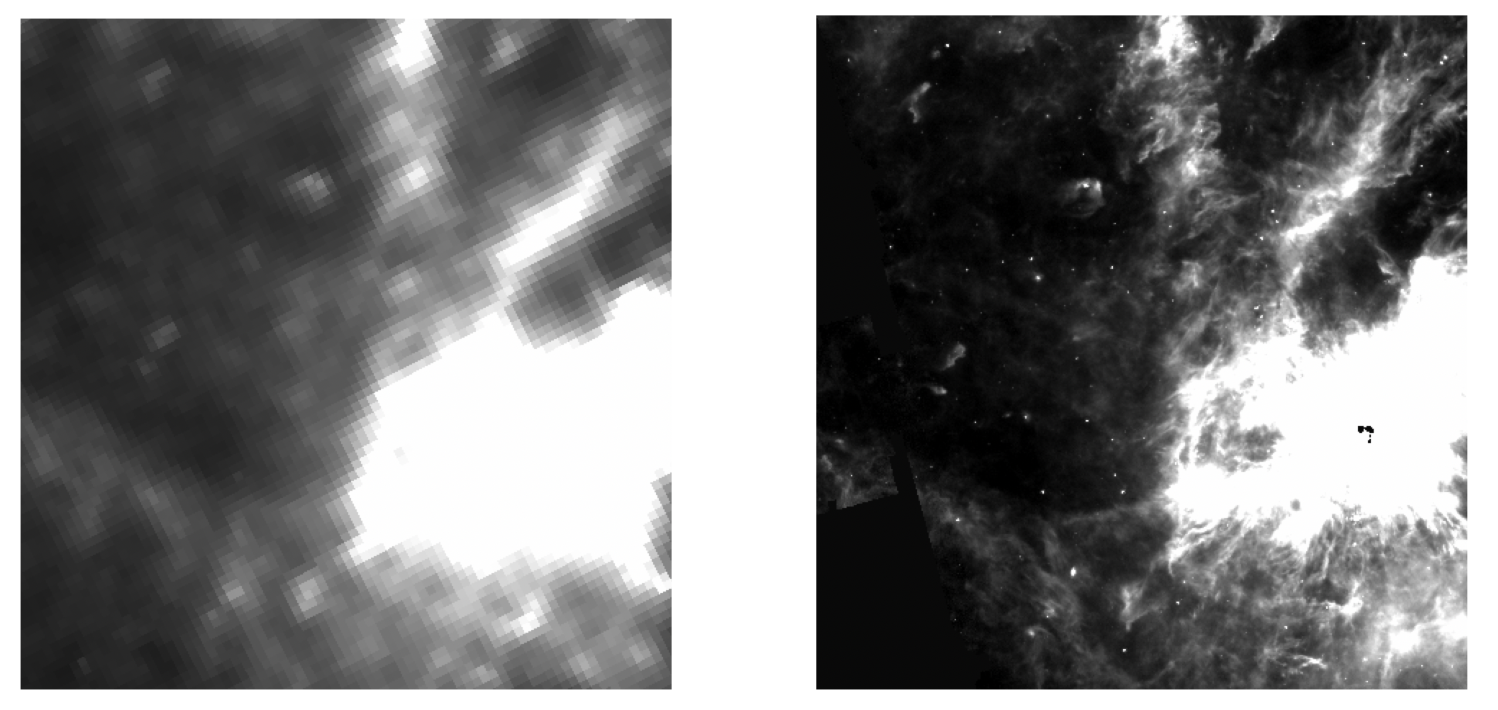
The instruments on JWST will have angular resolutions 10 times better than Spitzer and sensitivities over a hundred times better than current instruments. This figure shows the vast improvement between Spitzer 8 micron observations (left) and JWST MIRI F770W observations (right). We are able to study star formation at sub-parsec (0.05 parsec) scales in the Large Magellanic Cloud. With multi-band photometry with JWST of the N79 region, host to super star cluster H72.97-69.39, we have identified individual massive and low-mass young stellar objects in a crowded field, some of which are as small as 0.7 Msun. MIRI MRS Infrared spectroscopy has revealed the youngest and most embedded young stellar objects with ice and silicate features. High resolution interferometric, photometric, and spectroscopic data will be key to determining the formation process of super star clusters and the effect of the massive O stars on local and galaxy-wide scales.
James Webb Space Telescope Projects
-
JWST MIRI/MRS spectra of Eleven YSO Candidates in the N79 region of the Large Magellanic Cloud (accepted)
-
MIRI imaging of super star cluster candidate H72.97-69.39 location in the N79 region of the Large Magellanic Cloud to better understand to formation of young and massive clusters
-
NIRCam and MIRI band-merged catalog of young stellar objects in H72.97-69.39 complete down to 1 solar mass size objects
-
Characterizing the dusty sources in the N79 region of the Large Magellanic Cloud and the NGC346 region of the Small Magellanic Cloud
-
Comparing star formation in the Magellanic Clouds to even lower-metallicity galaxies such as NGC6822 and 1 Zwicky 18 with NIRCam and MIRI imaging
-
Star formation triggered by AGN jet in NGC 4258 with NIRCam imaging
 onayak.com